Bea Accepts the Treehouse Design Commission
Gente que viene y ¡Bah!Bea’s acceptance of the treehouse commission begins with refusal, pride, and a reluctant return to the work she has been offered. Ingrid Dvorak wants Bea to take charge of the project, but Bea first walks away, convinced that she has let a valuable opportunity slip through her fingers. She reconsiders only after her family challenges her decision; even then, she makes her possible acceptance conditional on meeting Diego and speaking with him. The first practical step toward the commission is not a finished agreement but a site visit, where Bea insists on treating the encounter as a professional transaction.
The Offer and Its Basis
Ingrid explains that a sketch alone will not satisfy the client and asks Bea to take charge of the work. Bea raises the possibility that Ingrid has approached her because Diego himself asked her to hire Bea. Ingrid’s account is more qualified: she says she has spoken to Diego about Bea, about her model, and about the possibility that she is the right person to build the house. The offer therefore rests, at least in part, on Ingrid’s assessment of Bea’s work and suitability; the exchange does not establish that Diego personally requested her appointment.
Bea initially declines before hearing Ingrid’s full proposal. Ingrid points out that Bea has not yet heard the terms, but the offer does not immediately overcome Bea’s resistance. The gap between an opportunity being available and Bea being ready to accept it gives the commission its first obstacle: she must decide whether her refusal is a considered boundary or a response she will later regret.
Refusal and Regret
After Bea says she has work, Ingrid makes a gesture indicating that she should leave. Bea departs stunned and describes herself as deeply upset. In retrospect, she sees the encounter as having cost her a remarkable chance to work with a great architect. She cannot settle on whether pride or dignity drove her refusal, naming both possibilities without entirely resolving the distinction. Her account makes the lost opportunity concrete while leaving her own motive somewhat unsettled.
The reaction at home is blunt. When Bea recounts what happened, a family member agrees that Ingrid was right and calls Bea foolish. The criticism adds to the pressure already created by Bea’s own regret: the refusal is no longer simply a private decision, because her family treats it as an avoidable mistake. Her mother then presses her directly to speak with Ingrid about being hired, even offering to give her a push if necessary. Bea fears that intervention and is tired of having nightmares; she decides to stop resisting what she now regards as the reality of the situation. She reflects that defeat can be less painful than continuing to fight it.
A Conditional Return
Bea goes back to Ingrid’s studio, but the return does not erase the earlier exchange. Ingrid is cold, as if her previous kindness has run out. Bea says there is a possibility she will accept the offer, but first she wants to see the client and talk to him. The qualification matters: she is not yet agreeing to proceed on Ingrid’s terms alone. She is establishing a condition for her own participation, requiring direct contact with the person whose house is to be built.
Diego is waiting outside the house when Bea arrives with Ingrid, and he is surprised to see her. Bea cannot tell from his impassive expression whether he is pleased. Rather than seek reassurance or reopen the question of how the offer came about, she asks where he wants the treehouse built. She deliberately keeps the exchange cool and professional, with no unnecessary questions, smiles, or gestures of friendliness. In her framing, Diego is buying her work, and nothing beyond that is included in the transaction.
The Site and the Emerging Commission
Diego leads Bea and Ingrid through an extensive wooded garden, described as covering hundreds of hectares. It contains firs, pines, walnut trees, almond trees, chestnuts, and oaks, ranging from very large trees to smaller ones. Bea acknowledges the beauty of the grounds, with their fountains, wooden benches, and secluded corners, and recalls having imagined walking there and losing herself among the vegetation. The actual visit sharply contrasts with that earlier fantasy: she does not want to be there under these circumstances and makes no effort to hide it.
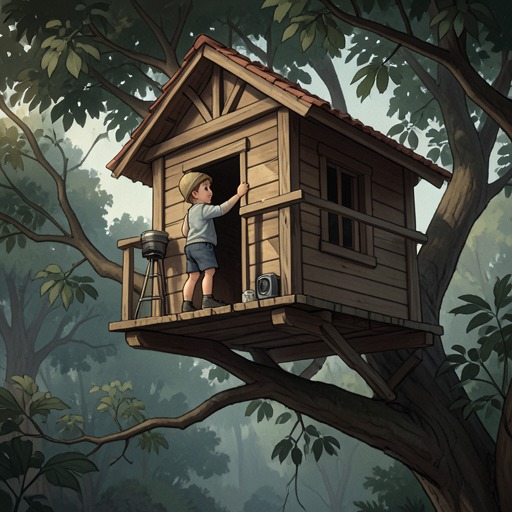
The tour brings the negotiation down to a particular tree. Diego takes them to a centuries-old oak and explains that his daughter likes it and that he thinks it could also work. Bea’s question about where to build the treehouse has thus led directly to an initial assessment of a possible site. The scene establishes a client, a location under consideration, and a design problem, but it does not describe a completed plan or settle every condition of the commission.
Significance of the Acceptance
The event turns on a change in Bea’s conduct rather than a sudden change in feeling. She moves from refusing before hearing the proposal to returning because the opportunity matters and her family has challenged her decision. Yet she does not arrive warmly reconciled to Ingrid or eager to please Diego. Her guarded manner preserves distance even as her actions bring her into the project.
That tension shapes the beginning of the work: Bea’s model has helped make her a possible candidate, but the commission now requires her to assess a real site and engage with the client. The garden’s abundance offers many possible settings, while the old oak gives the discussion its first concrete focus. Bea’s return therefore marks the start of practical consideration, not an uncomplicated surrender of her independence or a fully documented final agreement.